|
Power Cable Ampacity Rating
The CYMCAP software is dedicated to the calculation of ampacity and temperature rise calculations for power cable installations. The accuracy of the software provides increased confidence when upgrading power cable installations and designing new ones; maximizing the benefits from the considerable capital investment associated with them. It also helps increase system reliability and supports the proper utilization of the installed equipment.
Features
The CYMCAP software is dedicated to performing ampacity and temperature rise calculations for power cable installations. Determining the maximum current power cables can sustain without deterioration of any of their electrical properties is important for the design of electrical installations.
It addresses steady-state and transient thermal cable rating as per the analytical techniques described by Neher-McGrath and the International Standards IEC 287© and IEC 853©.
This software was developed jointly by Ontario Hydro (Hydro One), McMaster University and CYME International, under the auspices of the Canadian Electricity Association.
The validation of the results obtained with the CYMCAP software provides increased confidence when upgrading existing power cable installations and designing new ones, thus maximizing the benefits from the considerable capital investment associated with them.
Analytical Capabilities
- Iterative techniques based on Neher-McGrath and IEC-60287© methods
- Full compliance with North American practice and compliance with IEC standards IEC 60287©, IEC 60228©, IEC 60853©, etc.
- Detailed graphical representation of virtually any type of power cable. This facility can be used to modify existing cables data and enrich the cable library with new ones. This includes single-core, three-core, belted, pipe-type, submarine, sheathed, and armored cables
- Different cable installation conditions such as directly buried, thermal backfill, underground ducts or duct banks
- Pipe-type cables directly buried or in a thermal backfill
- Independent libraries and databases for cables, duct-banks, load curves, heat sources and installations
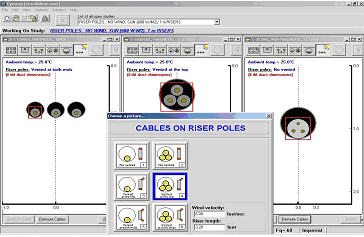
- Modeling of cables in air on riser poles, groups of cables in air, moisture migration, nearby heat sources and heat sinks, etc.
- Different cable types within one installation
- Non-isothermal earth surface modeling
- Cyclic loading patterns as per IEC-60853©
- Multiple cables per phase with accurate modeling of the sheath mutual inductances which greatly influence circulating current losses and thus de-rates the ampacity of cables
- All types of sheath bonding arrangements for flat and triangular formations are supported with explicit modeling of minor section lengths, unequal cable spacing, etc
Transient Analysis
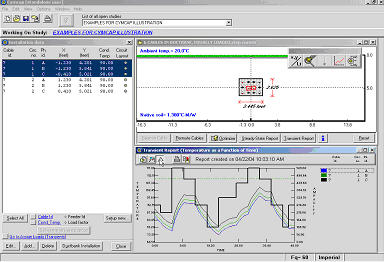
The program supports a Transient Thermal Analysis Option which includes the following:
- Ampacity given time and temperature
- Temperature analysis given time and ampacity
- Time to reach a given temperature, given the ampacity
- Ampacity and temperature analysis as a function of time
- User-defined load profiles per circuit
- Multiple cables per installation
- Circuits can be loaded simultaneously or one at a time
CYMCAP Additional Modules
Installations
The CYMCAP Additional Modules offer extended capabilities to the CYMCAP software, allowing modeling more installations, particularly non-standard installations. This includes the modeling of installations with multiple ductbanks and backfills each with different thermal resistivity; the calculation of the ampacity and temperature of cables in unventilated tunnels; the rating of cables in both filled and unfilled troughs; and the rating of cables in one or more non-magnetic casings.
Analyses
The CYMCAP Additional Modules allow performing several analyses of interest for cables installations like evaluating the magnetic flux density at any point on or above the ground of an underground cable installation, determining the positive and zero sequence impedances and admittances for all the cables present in an installation, performing short-circuit cable ratings, determining the optimal placement of several circuits within a ductbank given specified constraints and calculating the ampacity of two circuits crossing each other.
Multiple Duct Banks and Backfills
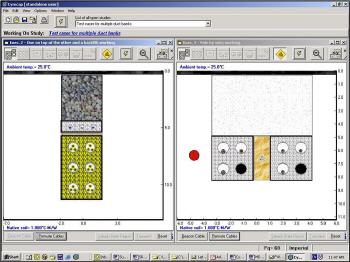
The Multiple Duct Banks and Backfills add-on module (MDB) is designed to determine the steady-state ampacity of cables installed in several neighboring duct banks and/or backfills with different thermal resistivity. The module presents a unique solution combining standard and non-standard calculation methods. The module computes the values of T4 (the external thermal resistance to the cable) using the finite element method and then the ampacity (or operating temperature) of the cable installation is obtained using the IEC standardized solution method.
The following capabilities are highlighted:
- Modeling unlimited number of rectangular areas with different thermal resistivity
- Modeling up to three duct banks in a single installation
- Modeling one heat source or heat sink in the installation
- Computation of the steady-state ampacity or temperature
- Transient analysis, cyclic loading and emergency ratings are supported
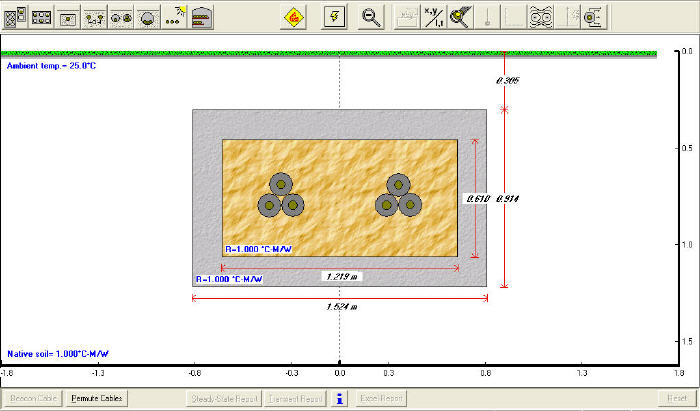
- Computation of the thermal rating of cables installed in filled troughs
Cables in Tunnels
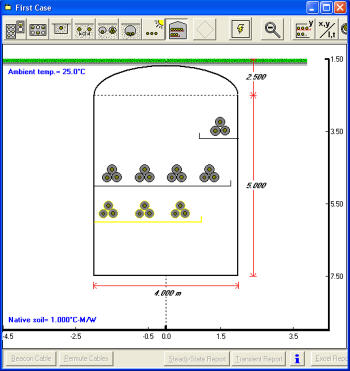
The optional Cables in Tunnels module allows the user to determine steady-state temperature and ampacity, cyclic loading, emergency rating and transient analysis for cables installed in unventilated tunnels. Note that only equally loaded cables having the same type and loading are considered. This add-on module supports a large variety of cable arrangements for single core (flat formations or trefoils) and three-core cables. Major features are:
- Modeling of a large variety of installation methods: laying on the floor; hanging from a wall; in ladder-type racks; or in cable trays
- Cables and groups of cables can be single-core or three-core. Single-core cables can be arranged in flat formations (vertically or horizontally) or in trefoil
- Computation of the steady-state ampacity or temperature. Cyclic loading using daily, weekly and yearly load factors. Computation of emergency ratings
- Ventilation in tunnels is supported for identical cables in trefoil or flat configuration as described in the IEC standard 60287-2-3© 2017. It includes a report to view the temperature profile along the ventilated tunnel.
Cables in Troughs
The thermal rating of cables installed in unfilled or in filled troughs is determined using the CYMCAP/UNF and the CYMCAP/MDB modules respectively.
In these modules, a trough (or a trench) is defined to be a long shallow rectangular-shaped excavation, where the walls, bottom and cover are made of concrete. The cables can be installed on the floor, hanging from supports on the walls or racks. The trough can be filled with a material with good thermal properties or it can be left unfilled (air filled). The heat transfer mechanism is different for filled and unfilled troughs and therefore they are treated independently.
Unfilled Troughs
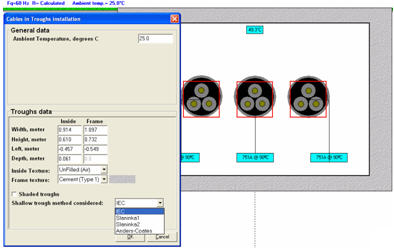
Initially, the only option to rate unfilled trough installations was to use the IEC standard. In this approach the cables ratings are calculated as for cables in free air, but the temperature inside the trough is computed according to the IEC Standard 60287-2-1©. The module has been improved significantly and includes three options in addition to the IEC standard to model a given trough installation: Slaninka Method 1, Slaninka Method 2 and Anders-Coates Method.
With the IEC standard, thermal resistivities of the soil and the trough’s cover are ignored. With the Slaninka Method 1, the thermal resistivity of the trough’s cover is considered. The Slaninka Method 2 considers both the thermal resistivities of the cover and the soil surrounding the trough. With the Anders-Coates method, in addition to the thermal resistivities of the soil and the cover, the wind velocity above the trough is taken into account. In all options the user can choose whether the trough is exposed to sun radiation or it is shaded. The approaches are all based on field research by independent parties and published in scientific journals.
Filled Troughs
Filled troughs are treated in the CYMCAP/MDB module as multiple backfills. Cables in filled troughs are rated in the CYMCAP software using:
- Finite elements method to compute the external-to-the-cable thermal resistance T4
- IEC Standards procedures to perform efficiently ampacity calculations
Besides, the module offers:
- Computes the temperature and steady-state unequally loaded ampacity as customary
- Facilities to move the troughs down and model asymmetrical troughs
- Ability to perform cyclic loading rating through the use of load factorss
Multiple Casings
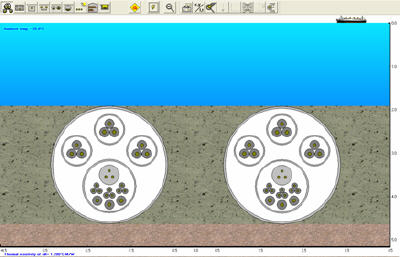
The Multiple Casings add-on module (MCAS) allows the user to determine the steady-state unequally loaded ampacity and/or temperature rating of cables installed in one or more non-magnetic casings. In the CYMCAP software, a casing is defined to be a large non-magnetic conduit filled with air, inside which cables in ducts and cables not in ducts can be installed. Casings can be immersed in water, placed on the sea bed or buried underground. No other filling material other than air is considered in the casing(s) or in the duct(s).
The module features many modeling facilities among which the following capabilities can be highlighted:
- Different burial environments are allowed: water or underground
- Modeling of any number of casings in parallel in the same installation
- Modeling of any number of ducts inside one or more casings at the same time
- Capable of modeling any number of circuits inside a casing and a duct
- Circuits in ducts and in casings can be multiple cables per phase
- Several materials are available to model ducts and casings, including non-magnetic metallic materials (PVC, Polyethylene, Earthenware, non-magnetic metal, etc.)
- Sizes of ducts and casings are not limited
Duct Bank Optimizer Module
The Duct Bank Optimizer add-on module allows the user to determine the optimal placement of several circuits within a duct bank. More specifically, the module can recommend various circuit configurations within a duct bank so that:
- The duct bank overall ampacity, i.e. the sum of the ampacities for all circuits, is maximized
- The duct bank overall ampacity, i.e. the sum of the ampacities for all circuits, is minimized
- The ampacity of any given circuit is maximized
- The ampacity of any given circuit is minimized
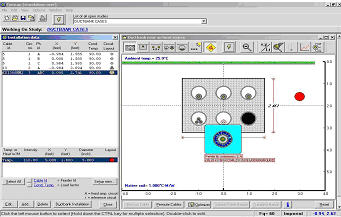
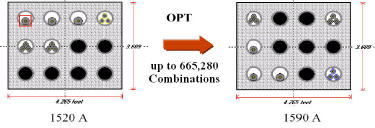
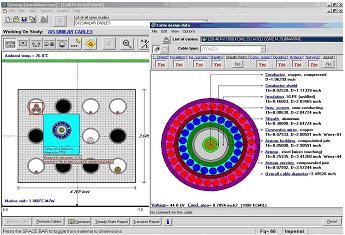
For a 3 by 4 duct bank with three trefoils and one three-phase circuit (one phase per conduit), there are up to 665,280 possible combinations. The elaborated mathematical algorithm of the module prevents the repetitive calculation of equivalent cases, therefore the solution is obtained very efficiently. The condition presented on the right hand side of the illustration shows the cable locations for maximum ampacity.
Magnetic Fields
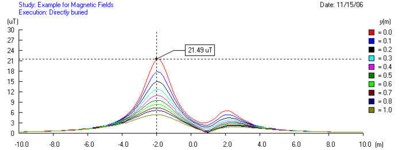
The Magnetic Fields Module (EMF) is an add-on module to the CYMCAP software. After a steady-state ampacity or temperature simulation, the module computes the magnetic flux density at any point on or above the ground of an underground cable installation. The output is a plot (or a table) of magnetic flux density versus position. Modeling features include:
- Infinite-length thin-wire two-dimensional approach
- Consideration of time-varying currents producing an elliptically polarized rotating magnetic vector
- The currents in a three-phase circuit can be unbalanced (in magnitude and phase)
- All media is assumed homogenous, isotropic and linear
- The induced currents are neglected
Cable Impedance Calculation
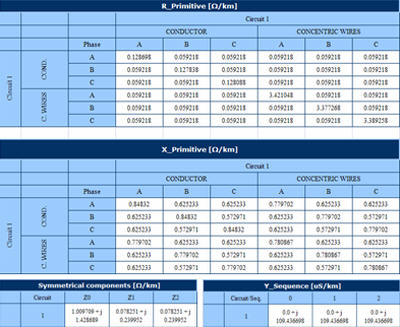
The Cables Impedance Calculation add-on module (ZMat) calculates the electrical parameters for cables necessary for performing load flow and short-circuit studies at the power frequency (50/60 Hz). The calculation of impedances is performed after a steady-state ampacity or temperature simulation has been successfully completed. The final results are the positive and zero sequence impedances and admittances for all the cables present in the installation.
All impedance and admittance matrices are displayed in the report: starting from the primitive matrices per section per metallic component, the bonding matrices, then the phase and circuit matrices and finally the resulting symmetrical components matrices. The following features are supported:
- Computation of the sequence impedances for all the cables present in an installation
- Computation of the sequence admittances for all cables present in an installation
- Multiple cables per phase are supported
- One or more neutrals can be represented and are taken into account in the calculations
- Resistivity of the soil can be changed
CYMCAP/SCR, Short-Circuit Cable Rating
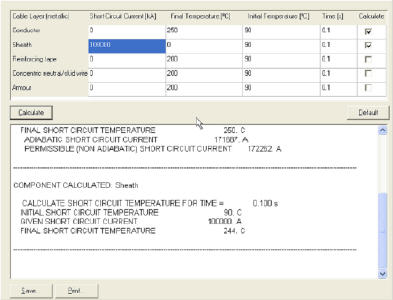
The Short-Circuit Cable Rating (SCR) add-on module is dedicated to the rating of cables for short-circuit currents. The implemented method is based on the IEC Standard 60949© (1988) “Calculation of thermally permissible short-circuit currents, taking into account non-adiabatic heating effects”. The CYMCAP program computes both adiabatic and non-adiabatic ratings. The module offers two possibilities according to the known input data.
- Compute the maximum short-circuit current that a cable component can carry given the short-circuit time together with the initial and final temperatures
- Compute the final temperature that a given cable component will reach for a specified short-circuit current, initial temperature, and time interval
Short-circuit ratings can be computed for all metallic layers supported in CYMCAP:
- Conductor
- Sheath
- Sheath Reinforcement
- Concentric Neutral / Skid Wires
- Armour
Circuits Crossing
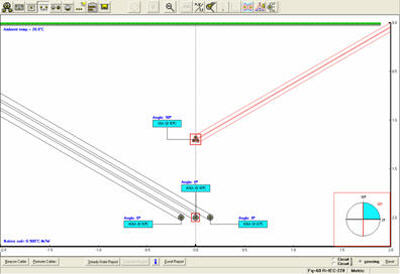
The Circuits Crossing (Xing) add-on module allows the user to determine the steady-state ampacity of two circuits crossing each other.
When two circuits cross each other, each of them behaves as a heat source for the other one. The amount of generated heat, the vertical distance between the crossing circuits and the crossing angle are the main parameters that influence the crossing rating. In the absence of crossing calculations, the general practice is to use the conservative result where the circuits are assumed to be parallel. When the circuits are parallel, the thermal interaction is maximum. It goes to a minimum when they cross each other at a right angle. The conservative approach unnecessarily de-rates both circuits. By using the Circuits Crossing module, one can achieve ratings up to 20% higher than the conservative ampacities that are obtained based on the parallel installation scenario. Modeling features include:
- Modeling of two circuits crossings each other in the same installation
- Circuits crossing directly buried underground, in buried ducts and in buried pipes underground
- Rating approach as per the IEC standard 60287-3-3©
|

 enlarge picture