|
Transient Stability Analysis
The Transient Stability Analysis module of the CYME power engineering software is dedicated to simulating electromechanical transients in electrical power systems. It features an extensive library of equipment and control models; the capability to include user-defined controls, a very flexible user-interface and powerful graphics.
The module utilizes the simultaneous implicit trapezoidal integration solution technique for network, machine and controller equations. The program supports the capability to test the step response of controllers and user defined modeling for system equipment and controllers.
The initial voltage profile of any balanced or unbalanced network is computed with balanced power flow algorithms namely the Newton Raphson or Fast Decoupled. The simulation in Transient Stability Analysis module will be for the equivalent balanced three-phase network.
Analytical Capabilities
- LLL, L-G, LL and LL-G fault application and removal
- Global setting of control parameters for generators, motors and electronically coupled generating units
- Line switching and line re-closing
- Single pole switching including line charging effects
- Load shedding and load adding
- Generation loss
- Disconnection of lines, cables and transformers
- Tripping and reclosing of protective devices
- Frequency-dependent modeling of generators
- Networks with multiple nominal frequencies
- Ability to monitor specific equipment during the simulation
- Load modeling as a function of voltage and frequency at individual bus bars or throughout the system
- Disconnection of static VAR compensators
- Addition and removal of shunts
- Direct on-line or assisted induction motor starting and stopping
- Automatic validation of maneuvers and their sequencing in time
- Verification of equipment and controller data
- Ability to vary the integration step during the simulation
- Ability to interrupt the simulation temporarily and restart
- Range validation for controller settings and simulation parameters
Control Model Library
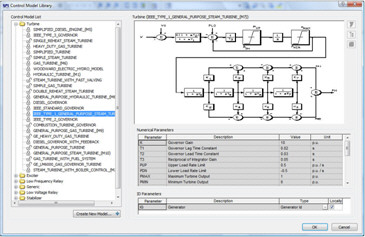
The control model library of the Transient Stability Analysis module is an extensive library of dynamic models of equipment and their controls. This includes default data values of the parameters, their description and block diagrams as per published transactions and papers.
This includes control models of:
- Round poles and salient poles generators
- Modeling of excitation systems taking saturation into account, based on IEEE® standards
- Power system stabilizers
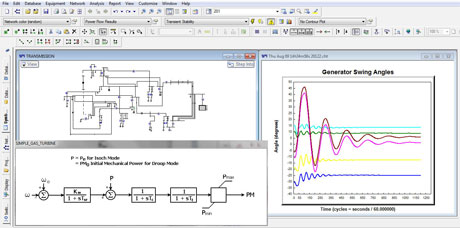
- Governor models comprising hydraulic, thermal, diesel, and gas turbines
- Detailed modeling of static-VAR compensators
- Under-voltage, under-frequency and frequency droop relays
- Impedance relay with typical circular trip characteristics including single reset time reclosing
- Induction motor models with frequency dependent modeling
- Dynamic modeling of distributed generation such as Wind Energy Conversion Systems (WECS), photovoltaic (PV cells), fuel cells and micro turbines
User-Defined Modeling
The Transient Stability Analysis module features a unique ability to supplement the existing array of control models for system equipment and controllers, giving the user the opportunity to model any desired control system using user-defined modeling.
The user-defined modeling approach is based on the premise of solving the user-defined equations. The program is provided with an extensive library of elementary functions and building block controls to model any control scheme, including system-wide operations.
The model can be created with a simple text editor and there is no need to recompile the software to integrate the new model into the library.
The control model library is so flexible in its design that the user can create or import into the library any control model created with the built-in user defined modeling functions. This includes any model created previously for the PSAF software or any new one that the user may wish to add to the CYME software library in order to include it in any study requiring such model. In addition the user can import dynamic model block diagrams in bitmap image format.
Dynamic Modeling of Distributed Energy Resources
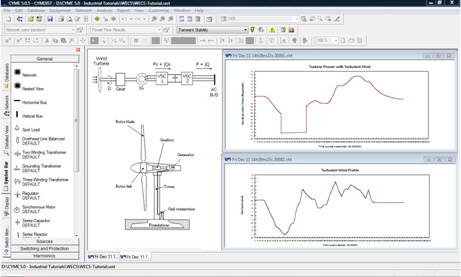
The Transient Stability Analysis module includes extensive modeling capability of Distributed Energy Resources (DER) equipment such as Wind Energy Conversion Systems (WECS), photovoltaic, fuel cell and micro turbine dynamics. The advanced solution algorithms provide the user with the necessary tools to carry out power system studies comprised of these types of installations.
|

 enlarge picture