|
Contingency Assessment and Restoration
An unscheduled outage can easily put a power system’s security at risk. Understanding the impact of plausible outages can help engineers identify weak points of their networks and put emergency switching plans in place.
The CYME Contingency Assessment and Restoration Analysis module is a comprehensive tool to study the impact of contingencies on the distribution system in order to find an optimal switching plan for power restoration.
Program Features
One of the possible impacts of equipment failures is the interruption of service to customers. Outage duration can extend beyond customers level of tolerance if no adequate switching plan considering equipment overloads and voltage violations has been planned. Therefore, contingency analysis is essential to engineers to assess the robustness of the networks by identifying potential problems with outages and planning maintenance in order to assure rapid service restoration.
The Contingency Assessment and Restoration Analysis module studies the what-if situation of outages on a radial system to establish viable switching plans.
The features of the module include:
- User-defined outage locations
- Batch mode single contingency simulations
- Outage data can be saved in an external file for easy re-evaluation of the same event at a later date
- Different restoration modes and objectives
- User-defined criteria for switching operations
- Illustrative one-line diagram display
- Detailed reports
With its many features, the Contingency Assessment and Restoration analysis module is a powerful tool to help engineers understand the strengths and weaknesses of a power system through the study of outage impacts at different locations. It suggests contingency switching plans, so that you can be prepared for quick intervention in case of unplanned loss of supply.
Restoration Plan
The analysis simulates the outage at the user-defined locations and evaluates all the alternatives to propose a sound switching plan.
The module takes into account the selected restoration mode and restoration priority.
The selection criterion is also defined by the relative importance of different objective functions, such as:
- Minimize the number of switching operations
- Maximize the total load restored
- Balance the load among available feeders
- Minimize the loading of every component
- Minimize the distance between the customer and the substation
The analysis also respects the following user-defined criteria:
- Maximum equipment loading limits
- Maximum and minimum voltage limits
- Operable switching devices
- Number of backup feeder layers
- Load factors
Satisfying all the user-defined criteria, the module provides the best-suited solution specific to each user’s operating conditions.
Meaningful Results
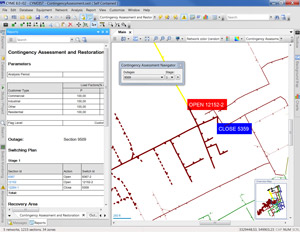
Results are presented in the form of both one-line diagram display and reports.
One-line diagram display includes:
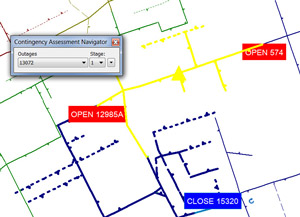
- Navigator to display the post-contingency network status and switching plan for each single-contingency scenario in a batch mode simulation
- Color-coding to show outage location, restored sections, un-served area and isolated sections
- Color-coding to show switching operations
- Tags to show information on the switched devices
Reports include:
- Detailed report for each outage, listing the proposed switching plan, the load restoration and the area left un-served
- Report listing the weak points in the network which would be overloaded when a switching operation is attempted
The information available helps engineers study multiple what-if scenarios, to understand the security of the system, and to be better prepared for undesired service interruption.
|

 enlarge picture