|
Cable Historical Operating
Temperature Estimator
The Cable Historical Operating Temperature Estimator (CHOTE) is a software application that offers an innovative way to evaluate the temperature at which underground cable systems have operated during their in-service life. The CHOTE software allows identifying, qualifying and quantifying important conditions on the network.
Program Features
There are many underground (UG) transmission/distribution systems that have been in operation for more than 50 years (a few even longer than 100 years). Utilities are facing the need to provide reliable service with an aging cable infrastructure. UG system planners and operators currently do not know if (which, where, when and for how long) cables have exceeded, at some point in time, their operating or emergency temperature.
The Cable Historical Operating Temperature Estimator (CHOTE) software application offers an innovative way to evaluate the temperature at which underground cable systems have operated during their in-service life.
The CHOTE software provides important information to transmission and distribution engineers. It identifies, qualifies and quantifies the following important conditions:
- The cables and cable installations that have been exposed to thermal damage. It identifies the cables that have exceeded their normal and/or emergency temperatures during their in-service life.
- For how long and how much the applied over-temperatures compare with the original design characteristics.
Cable engineers can take advantage of this information to plan additions and/or replacements in a more informed manner. By using the CHOTE software an engineer knows for how long each cable has exceeded a given target temperature. As a result, there is valuable information to estimate the remaining life of a cable, which can be used to manage more efficiently capital investment in cable installations. For example, an investment to substitute a cable can be postponed, or planned to do it “just in time”, with greater certainty thanks to the information that the CHOTE software offers.
Transient Calculations
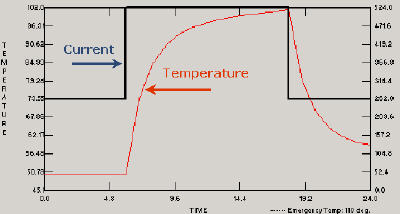
Cable operating temperature very much depends on the load profile of the cable. In other words, the temperature of a cable depends on the intensity of the current and its variation over time. As a result, cables have different ratings, i.e. steady state, cyclic, emergency and short circuit. Since cables installations have thermal inertia, it takes time to heat the cable and its surroundings. A typical response to a step overload of 100% lasting 12 hours is shown in the figure below. One can appreciate that the temperature of the cable exponentially follows the changes in current.
Application Highlights
Using transient simulation, the CHOTE program processes archived loading information usually available through the SCADA/PI systems on an hourly (or 15-minute) resolution. Thus, the input to the temperature estimator is the current of all cables on a particular installation. The CHOTE software is capable of automatically analyzing all the thermal sections of a system. This can include transmission and even the entire distribution system (manhole-to-manhole). The temperature estimator can process archived information for any length of time. Currently, up to 10 years of historical data can be used.
The output of the software is a list of cable sections that have exceeded the admissible normal and/or emergency operating temperatures defined by the user. It produces a global ranking report. The cables that exceed their target (normal/emergency) temperatures for the longest time are listed first in the report. The output indicates not only where, but also when the hot spots have occurred.
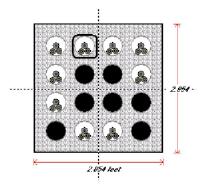
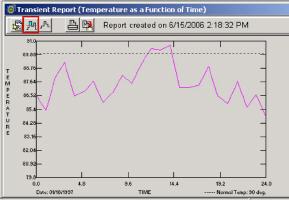
The CHOTE software is capable of indicating the locations along the cable run that have exceeded a target, either normal or emergency temperature. It will give the thermal section (manhole-to-manhole), the feeder name, the dates, times and for how long certain temperature was exceeded. Additionally, the application shows graphically the location of the cable with problems in the duct bank and even allows re-creating the condition that produced the temperature problem.
Location of the cable exceeding the target temperature of 90°C.
Re-creation of the cable temperature curve. Note how it exceeds the 90°C target.
The program can perform what-if scenarios to study the impact of additional of new cables. This software can also be used to determine the remaining loading capability of one or more of the cables installed in a given duct bank.
|

 enlarge picture